Zheng Yi, Liaoning Xinda Talc Group Co., Ltd.
Abstract
Talc is a widely used platy functional filler in the coating industry, and its purity exerts a remarkable effect on the adhesion performance between coating films and substrates. In this paper, five grades of industrial talc with different purities (85%~99%) were selected as research objects. Waterborne epoxy coatings were prepared and subjected to adhesion tests. Combined with contact angle measurement and fracture morphology observation, the mechanism by which purity affects adhesion was investigated. The results show that as talc purity increases from 85% to 99%, the pull-off adhesion rises from 3.2 MPa to 6.7 MPa, with an increase of approximately 109%, and the cross-cut adhesion grade improves from Grade 2 to Grade 0. Impurities reduce adhesion mainly through three approaches: weakening filler wettability, inducing interfacial defects and increasing the oil absorption value of the system. For coating systems with high adhesion requirements, talc with a purity of no less than 95% is recommended.
Keywords: talc; purity; coating; adhesion; interface
1 Introduction
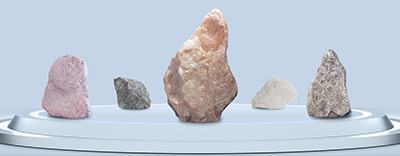
Talc (3MgO·4SiO₂·H₂O) is a natural silicate mineral with a platy structure. Owing to its low cost, stable chemical properties and smooth texture, it is extensively used as fillers and functional additives in coatings to improve the hardness, wear resistance and construction performance of coating films. Industrial talc is often associated with impurities such as calcium carbonate, chlorite, mica and iron oxides. Due to the variation of ore grade from different producing areas, the purity of commercially available talc fluctuates between 85% and 99%.
Most existing studies focus on the effects of talc fineness and dosage on coating film properties, while systematic experimental data regarding the relationship between purity and adhesion remain insufficient. Impurities may alter the dispersion and wetting behavior of fillers in binders, forming weak boundary layers at the coating-substrate interface and thereby impairing adhesion. Therefore, this paper conducts controlled experiments to investigate the influence of talc purity on coating adhesion and analyzes its action mechanism.
2 Experimental Section
This chapter describes the material formula and adhesion test methods adopted in the experiment.
2.1 Materials and Formula
Five types of industrial talc with purities of 85%, 90%, 95%, 98% and 99% were selected, and their median particle sizes were all controlled at approximately 10 μm. Waterborne epoxy resin emulsion was used as the binder, and tin plates derusted and polished with 240-grit sandpaper served as substrates. The talc dosage was fixed at 15% of the total mass of the formula, and other components remained unchanged.
2.2 Test Methods
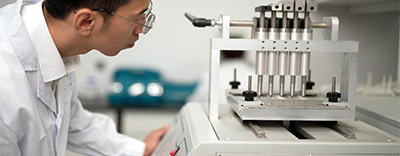
After spraying, the dry film thickness of the coating was controlled at (40±5) μm, followed by curing for 7 days under standard conditions (23 ℃, 50% relative humidity). Adhesion was measured in accordance with GB/T 5210—2006, Paints and varnishes — Pull-off test for adhesion, and the arithmetic mean value was calculated from five parallel samples for each group. The adhesion grade was evaluated based on GB/T 9286—2021, Paints and varnishes — Cross-cut test (Grade 0 represents the best performance and Grade 5 the worst). The sessile drop method was adopted to measure the water contact angle on the coating surface to characterize wettability.
3 Results and Discussion
This chapter presents the adhesion test results and discusses the mechanism through which purity affects adhesion.
3.1 Adhesion Test Results
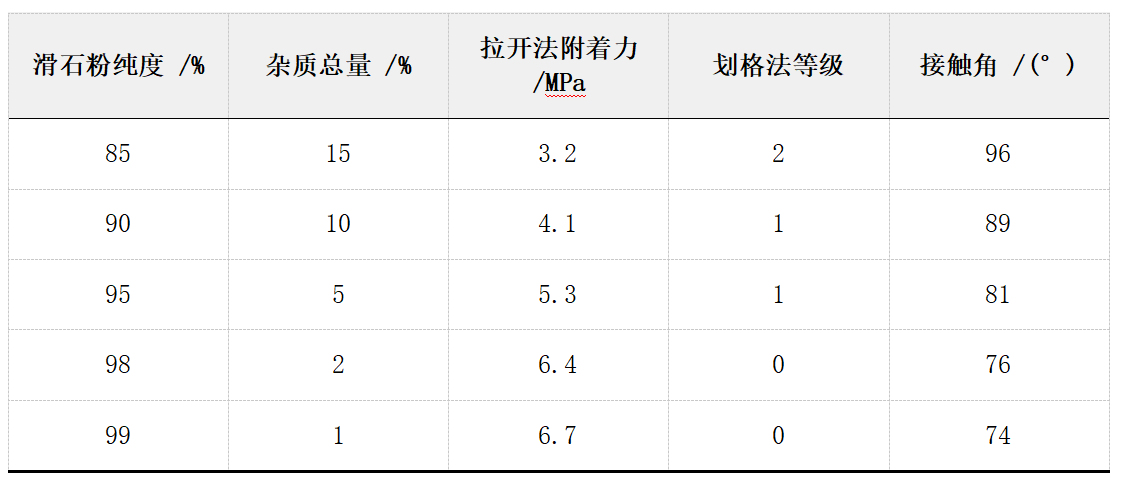
As shown in Table 1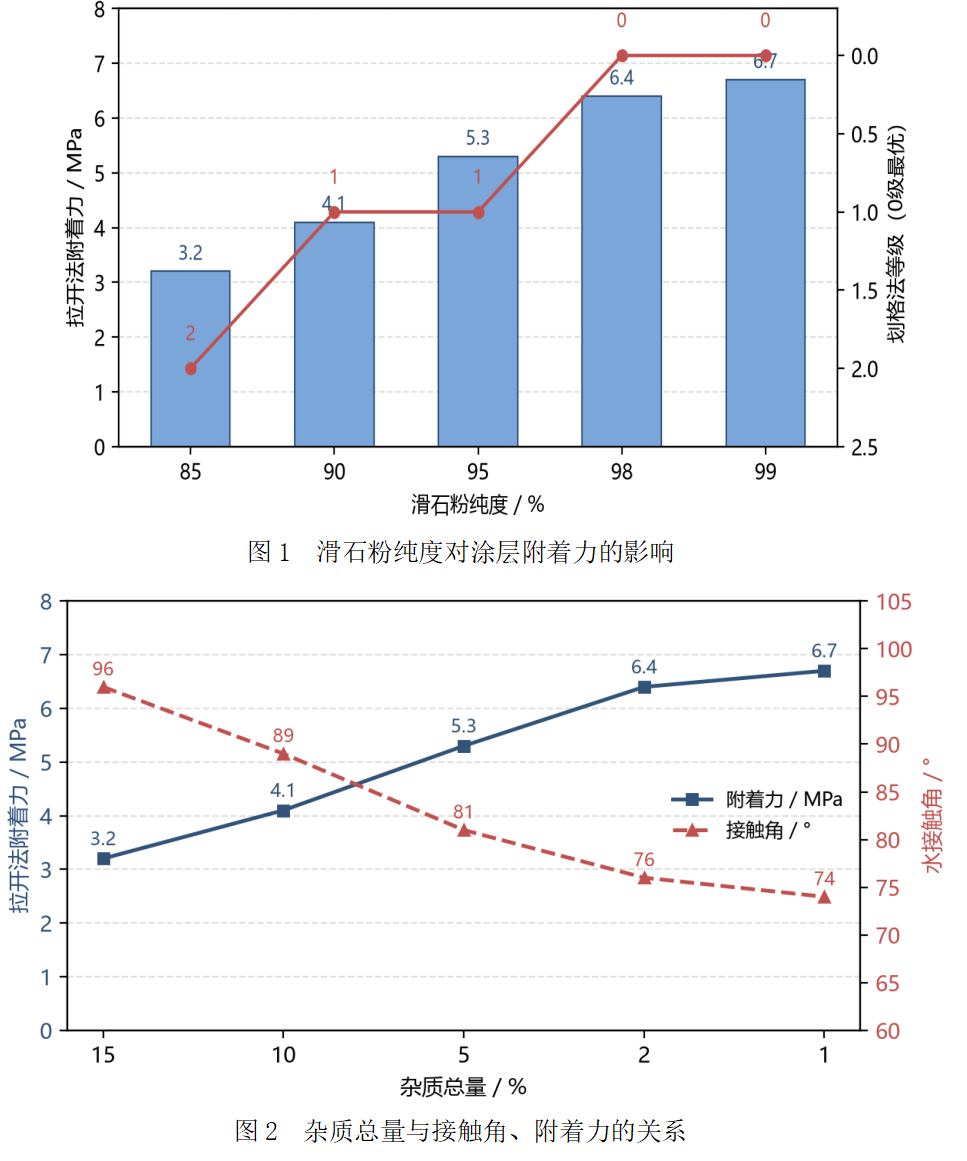
3.1 Adhesion Test Results
As shown in Table 1 and Figure 1, coating adhesion increases significantly with the rise of talc purity. When the purity increases from 85% to 99%, the pull-off adhesion increases from 3.2 MPa to 6.7 MPa, with an increment of about 109%, and the cross-cut adhesion improves from Grade 2 to Grade 0. After the purity reaches 98%, the growth of adhesion slows down and the marginal benefit decreases obviously.
3.2 Mechanism Analysis
(1) Deteriorated wettability. Associated impurities are mainly calcium carbonate and chlorite, which feature strong surface polarity and poor compatibility with resins. Figure 2 demonstrates that the total impurity content is positively correlated with the coating contact angle and negatively correlated with adhesion, indicating that impurities weaken the wetting and encapsulation of filler particles by binder resins and reduce the bonding strength at the filler-resin interface.
(2) Interfacial defects. Poorly wetted impurity particles act as stress concentration points inside the coating film. Observation of fracture surfaces after pull-off tests reveals white spots enriched with fillers on the peeled surfaces of low-purity coatings. Failure mostly occurs at impurity-enriched zones, which is typical interfacial failure.
(3) Increased oil absorption value. Impurities raise the oil absorption of the filler system. At the same dosage, more resin is adsorbed by fillers, the amount of effective film-forming binder relatively decreases, and the compactness and cohesive strength of the coating film decline, which indirectly weakens adhesion.
In summary, the effect of talc purity on adhesion arises from the synergistic action of three factors: wettability, interfacial defects and oil absorption value, among which deteriorated wettability is the dominant factor.
4 Conclusions
1. Talc purity has a significant effect on coating adhesion: as the purity increases from 85% to 99%, the pull-off adhesion rises from 3.2 MPa to 6.7 MPa with an increase of approximately 109%, and the cross-cut adhesion grade improves from Grade 2 to Grade 0.
2. Impurities reduce adhesion through three pathways: weakening filler wettability, introducing interfacial stress concentration points and increasing oil absorption value, and deteriorated wettability is the dominant mechanism.
3. For coating systems with high adhesion requirements, talc with a purity of no less than 95% is recommended. Further purification after the purity exceeds 98% brings limited marginal benefit, so cost should be taken into comprehensive consideration.
References
1. GB/T 5210—2006, Paints and varnishes — Pull-off test for adhesion[S]. Beijing: Standards Press of China, 2006.
2. GB/T 9286—2021, Paints and varnishes — Cross-cut test[S]. Beijing: Standards Press of China, 2021.
3. Editorial Board of Coatings Technology. Coatings Technology[M]. 4th ed. Beijing: Chemical Industry Press, 2010.