Zheng Yi, Liaoning Xinda Talc Group Co., Ltd.
Introduction: A Key Indicator for Property Decoding
In the eyes of coating formulators, talc is far more than just a volume-increasing filler. As a functional powder material, talc, with its unique lamellar structure and physicochemical properties, exerts a profound influence on the processing performance, application behavior of coatings, as well as the protective and decorative effects of the final paint film. Among numerous technical parameters for evaluating talc quality, the oil absorption value holds a pivotal position. It not only characterizes the interaction between powder and binder, but also serves as a core link connecting formulation cost, production process and coating performance.
1. Scientific Definition and Determination Principle of Oil Absorption Value
In professional terms, the oil absorption value generally refers to the minimum mass of refined linseed oil required to fully wet 100 grams of talcum powder sample and form a uniform paste under specified conditions, expressed in grams (or converted to mL/100g). This seemingly simple test actually reflects the sum of two physical processes inside the powder: the physical retention of liquid by capillary voids formed by particle stacking, and the adsorption and spreading of liquid molecules on particle surfaces.
From the perspective of coating science, the oil absorption value of talc is directly associated with the critical pigment volume concentration (CPVC) of coatings. CPVC is the critical point at which a coating transforms from a dense film to a porous film, and the oil absorption value is a key parameter for calculating CPVC. An accurate understanding of oil absorption value is a prerequisite for scientific formulation design.
2. Grading Characteristics and Process Adaptability of Oil Absorption Value
The oil absorption value of talc is significantly affected by raw ore quality and grinding processes. It is generally divided into three characteristic ranges: low, medium and high, each corresponding to different process performances and application orientations.
1. Low oil absorption talc (usually below 30g/100g) features regular particle surfaces with few defects. It exhibits excellent low liquid absorption in coating production, can be rapidly wetted by resin with low dispersion energy consumption. This type of talc is suitable for high-filler systems or high-solid-content coatings. It can carry more powder while maintaining fluidity and helps control costs.
2. Medium oil absorption talc (approximately 30–45g/100g) is the most widely used grade on the market. It consumes resin moderately; it will neither raise costs excessively nor cause insufficient anti-settling performance due to weak adsorption. In dispersion processes, this talc tolerates a wide range of shear forces and readily achieves a stable dispersed state.
3. High oil absorption talc (above 45g/100g) is usually produced by ultra-fine grinding. It has fine particles, well-preserved lamellar structure and large specific surface area. Its strong capillary adsorption effect enables resin to not only fill inter-particle gaps but also be firmly adsorbed onto particle surfaces. This adsorption brings three process benefits: first, thickening effect — the adsorbed layer increases the effective particle volume and raises system viscosity; second, thixotropy build-up — adsorbed resin molecules form bridges between particles, endowing the system with thixotropy for anti-sagging and anti-settling; third, interface reinforcement — the compact adsorbed layer strengthens the interfacial bonding between resin and powder in the cured film, improving mechanical properties.
For high oil absorption talc, formulators need to balance its process challenges (such as high viscosity and difficult dispersion) against performance benefits (such as anti-settling, matting and anti-corrosion). By adjusting wetting and dispersing additives and resin dosage, its characteristics can be converted into coating advantages.
3. Microscopic Origin of Oil Absorption Value: Morphology and Surface Chemistry
The oil absorption value of talc is fundamentally determined by its microscopic morphology and surface chemical properties.
The theoretical structure of talc mineral is hydrous layered magnesium silicate. Its crystal consists of one magnesium-oxygen octahedral sheet sandwiched between two silicon-oxygen tetrahedral sheets. This structure gives talc two features closely related to oil absorption:
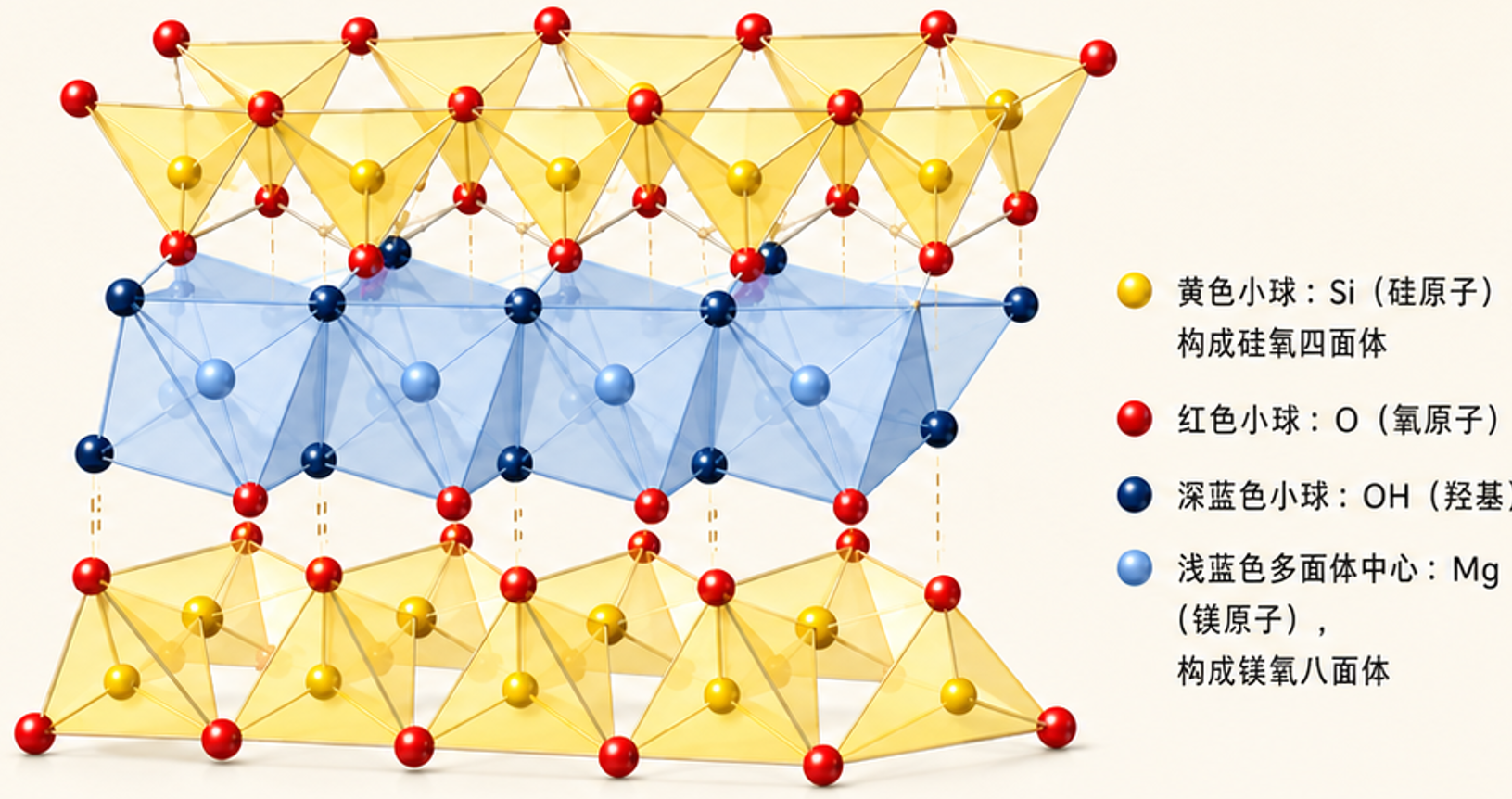
1. Lamellar morphology and high aspect ratio: Talc produced by ultra-fine grinding can well retain its natural lamellar crystal habit, with an aspect ratio often reaching tens or even hundreds of times. These tiny lamellae stack in complex ways, creating a large specific surface area and abundant inter-particle voids that provide physical space for oil absorption.
2. Surface characteristics and oleophilic tendency: Talc crystal layers are bound by weak van der Waals forces. Its surface lacks hydrophilic active sites, and its natural hydrophobic and oleophilic property allows oily media to spread and wet its surface more easily. This surface chemical property determines that talc has good compatibility in oily systems.
It is worth noting that the fineness of talc generally correlates positively with oil absorption value: the finer the powder, the larger the specific surface area, the higher the porosity of particle packing, and the higher the oil absorption value.
4. Double-Edged Sword Effect of Oil Absorption Value on Coating Performance
The oil absorption value of talc acts as a regulator in coating formulations, and its impact runs through the whole production and application process.
1. Impact on CPVC and mechanical properties
Oil absorption value is directly linked to coating CPVC. Talc with a high oil absorption value requires more resin binder to wrap its surface and fill voids. If the oil absorption value is excessively high while resin dosage is insufficient, the coating cannot form a continuous film, resulting in reduced adhesion, porosity and chalking. Meanwhile, properly dosed high oil absorption talc can form a strong anchoring effect with resin. Since talc is soft (Mohs hardness 1), it also provides sandability, making primer films smooth and easy to sand.
2. Impact on viscosity and thixotropy
During coating production, the oil absorption value of talc manifests as a thickening effect. A higher oil absorption value contributes more to system viscosity. This property has two sides in practical application:
Positive: Auxiliary anti-settling. High oil absorption talc can absorb part of solvent and resin to form a gel network. When used together with fumed silica, it effectively prevents hard sedimentation.
Negative: Higher difficulty in wetting and dispersion. High oil absorption requires more dispersant and longer dispersion time; otherwise, re-coarsening or flocculation may occur.
3. Impact on optical performance (matting)
Talc with a high oil absorption value usually delivers better matting performance. This is because high oil absorption is often accompanied by a larger specific surface area and more complex microscopic morphology. When the coating dries, these fine talc lamellae create micro-roughness on the surface, disrupting specular reflection of light and producing a matte finish. This property is widely used in wood coatings to adjust film gloss.
4. Impact on medium resistance and anti-corrosion performance
Ultra-fine talc with high oil absorption features densely stacked lamellar structures that effectively lengthen the penetration path of water molecules and corrosive ions. In addition, talc is chemically stable (pH 8–9, weakly alkaline). In anti-corrosion coatings, it can neutralize acidic substances and improve the coating’s resistance to chemical corrosion.
5. Trade-offs and Selection Strategies in Formulation
In practical applications, coating engineers must carry out systematic trade-offs and formulation adjustments according to the oil absorption value of talc:
When low oil absorption talc is selected: A higher powder loading can be designed to reduce formulation costs. Attention should be paid to the anti-settling performance of the system, and extra anti-settling agents may be required. Such products are suitable for cost-effective high-solid-content systems.
When high oil absorption talc is selected: The dosage of resin or wetting and dispersing additives must be increased accordingly to ensure full wetting and encapsulation of pigments and fillers. Although formulation costs rise, better anti-settling, matting efficiency and barrier performance can be obtained. Such products apply to functional topcoats or high-performance anti-corrosion systems.
Furthermore, with the development of modern powder modification technology, surface treatment can be used to tailor the oil absorption behavior of talc. For example, surface coating modification with silane coupling agents or fatty acids can reduce the apparent oil absorption value without changing its morphology, improve dispersion in specific resin systems, and achieve a new balance between performance and cost.
6. Conclusion
The oil absorption value of talc is far from an isolated laboratory datum. It serves as a bridge connecting the microscopic structure of powder and the macroscopic performance of coatings, and acts as a key reference for guiding formulation design, optimizing production processes and predicting coating properties. For coating engineers, an in-depth understanding of the definition, origin and multiple performance impacts of oil absorption value means taking the initiative to utilize talc as a multi-functional filler. As coating technology develops toward high performance, low VOC and multi-functionality, precise control and skillful application of oil absorption value will remain an important pillar for formulation innovation and product upgrading.