The essence of hiding is light scattering plus absorption. White pigments rely mainly on light scattering; scattering only occurs at the interface between two media with different refractive indices.
Zheng Yi, Liaoning Xinda Talc Group Co., Ltd.
I. Formula Logic:
Δn = nₚ (refractive index of pigment) − nₘ (carrier medium: resin / water / air). A larger Δn → stronger light scattering → higher hiding power
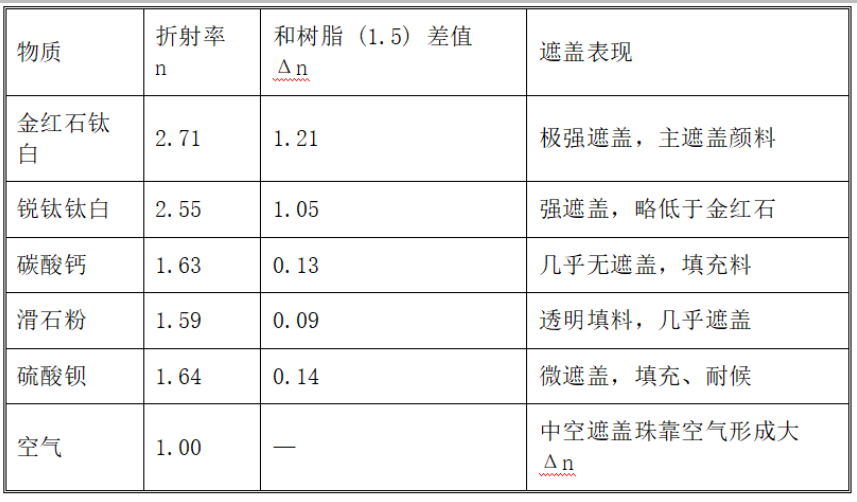
1. If Δn ≈ 0 (pigment refractive index ≈ resin): almost no light scattering, the pigment is completely transparent with no hiding effect. Examples: talcum powder n=1.59, calcium carbonate n=1.63, resin n≈1.5. The difference is small, so they can only serve as fillers and barely have hiding power.
2. The greater Δn is, the more intense the interfacial reflection and refraction. A large amount of light is reflected back and cannot penetrate the paint film, covering the underlying color. Example: rutile titanium dioxide n=2.71, resin n=1.5, Δn=1.21. It has the largest difference among white pigments and boasts top-tier hiding power.
II. Comparison of Hiding Power and Refractive Index of Common Raw Materials
III. Other Factors Affecting Hiding Beyond Refractive Index
3.1 Brief Introduction to Other Factors
1. Particle size: The refractive index is the foundation. When the particle size matches the wavelength of visible light (0.2–0.3 μm), the scattering efficiency peaks. Even with a high refractive index, excessively coarse or fine particles will reduce hiding power.
2. Light absorption capacity of pigments: Black pigments (carbon black) achieve hiding by fully absorbing light instead of scattering, which has nothing to do with the refractive index. (As stated by the manager, black itself provides a certain hiding capacity.)
3. Dispersibility: Pigment agglomeration reduces scattering interfaces. With the same refractive index, better dispersibility brings higher hiding power.
4. Dosage and paint film thickness: Higher pigment concentration and thicker paint film raise the probability of light being intercepted.
Deviation of particle size from the optimal range will lead to an obvious drop in hiding power:
(1) Particle size less than 0.2 μm: Excessively fine particles see a sharp rise in surface energy, and the powder is highly prone to agglomeration. The effective scattering interfaces decrease, which not only lowers hiding power but also increases the dispersion difficulty of the system;
(2) Particle size greater than 0.3 μm: At the same dosage, the number of powder particles decreases, the light scattering sites per unit volume are reduced, the chance of light penetration rises, and hiding power decreases accordingly. Nevertheless, large-size particles generally have better dispersibility.
This rule also applies to composite powder systems: if the particle size matching of multiple powders in a composite formula is unbalanced, the overall hiding effect will be greatly compromised even if the main pigment titanium dioxide has excellent performance.
3.2 Powder Dispersibility: Agglomeration Directly Consumes Scattering Interfaces
Regardless of the powder’s refractive index, agglomeration is a major factor weakening hiding power. After powder particles agglomerate, many small particles gather into large agglomerates. A large number of original independent two-phase scattering interfaces merge and disappear, and the effective light scattering area is greatly reduced.
Dispersibility exerts an especially prominent influence in composite and modified powder systems: unmodified mineral fillers have strong surface polarity and tend to agglomerate in organic resins. They may also entrap main hiding pigments such as titanium dioxide, preventing titanium dioxide from being fully dispersed to perform its function. Proper surface modification can improve the surface compatibility of powder, deagglomerate particles and enhance dispersion uniformity, markedly lifting the overall hiding power without changing the refractive index. Conversely, excessive modifier dosage or improper modification processes that trigger secondary agglomeration will also degrade hiding performance.
3.3 Optical Properties of Pigments: Special Rules for Light-Absorbing Pigments
The above rules about refractive index and particle size mainly apply to white and light-colored scattering-type pigments and fillers. Black pigments (such as carbon black) follow a completely different hiding mechanism. Carbon black achieves hiding through full-band absorption of visible light. Light is completely absorbed upon contact with particles with no scattering or reflection. Therefore, its hiding performance has no direct correlation with the refractive index or particle size difference. In formulas for black-and-white composite and dark-colored systems, the two hiding mechanisms need to be distinguished for targeted formula design.
3.4 Dosage and Paint Film Thickness
Within a reasonable range, higher dosage of pigments and fillers and greater thickness of the finally formed paint film/product increase the possibility of light being intercepted, scattered and absorbed during propagation, delivering a better hiding effect. When the pigment dosage reaches the critical saturation value, further dosage increase will barely improve hiding power, and may cause problems such as increased system viscosity, poor dispersion and higher costs. There is also a critical value for paint film thickness; hiding will no longer improve significantly once this threshold is exceeded.
IV. Analysis of Hiding Variation in Powder Modification and Composite Systems Based on Refractive Index Principle
The optical mechanism above clearly explains the fluctuation rule of hiding power before and after composite powder modification, which is a core application scenario in industrial production.
4.1 Organic Surface Modification (Coupling Agents, Stearic Acid, Surfactants, etc.)
The core of organic modification is to coat an organic molecular layer on the powder surface to change the surface polarity and dispersibility of particles. It exerts two types of influences on hiding power:
Positive influence: Appropriate addition of modifiers effectively breaks native agglomeration, allowing composite powders (titanium dioxide + calcium carbonate / talcum powder, etc.) to disperse uniformly in the carrier and fully release scattering interfaces. At this time, the bulk refractive index of the powder remains unchanged. Only dispersibility is optimized, bringing a slight rise in overall hiding power;
Negative influence: Excessive modifier dosage forms an overly thick organic coating layer on the powder surface. The refractive index of the organic layer is close to that of the resin medium, which narrows the effective refractive index difference Δn between the powder and the carrier, weakens light scattering capacity, and ultimately reduces hiding power. Meanwhile, excess modifiers tend to cause secondary particle agglomeration and further worsen hiding performance.
The compatibility of modifiers also needs to be considered for multi-component composite powders: if modifiers selected for different powders conflict with each other, flocculation and delamination will occur in the system accompanied by large-scale particle agglomeration, resulting in a sharp drop in hiding power.
4.2 Inorganic Coating Modification (Silicon Dioxide, Aluminum Oxide, Titanium Sol, etc.)
Inorganic coating falls into two application scenarios with remarkably different effects:
Standard inorganic coating of titanium dioxide: Rutile / anatase titanium dioxide is routinely coated with aluminum oxide and silicon dioxide on the surface to inhibit the photocatalytic activity of titanium dioxide and prevent agglomeration during storage and use. The thickness of this coating layer is precisely controlled so that it will not significantly change the overall refractive index of titanium dioxide. It stabilizes hiding performance while improving weather resistance. If the coating layer is too thick or uneven, the refractive index difference will decrease and hiding power will decline;
High-refractive-index inorganic coating for ordinary fillers: Coating high-refractive-index substances such as titanium dioxide on the surface of low-refractive-index fillers including calcium carbonate and talcum powder can directly raise the overall refractive index of the powder and increase Δn with resin. This is a functional hiding-enhancing modification that can significantly strengthen the hiding effect of composite systems.
4.3 Mechanical Modification (Dry Grinding, Deagglomeration Treatment)
Simple mechanical grinding and dispersion are physical modifications without chemical coating, which only change particle size and agglomeration state: Moderate grinding and deagglomeration eliminate caking, optimize dispersion and raise hiding power; Over-grinding reduces particle size below the optimal scattering range, or fine particles re-agglomerate after grinding, both of which will reduce hiding power.
V. Summary and Industrial Application Suggestions
Core logic: The refractive index difference Δn is the innate basis for powder hiding power. For white systems, rutile titanium dioxide and other high-refractive-index pigments are preferred. Mineral fillers are only used for filling and cannot act as the main hiding component due to their refractive index close to that of resin.
Particle size control: Strictly control the particle size of main hiding pigments such as titanium dioxide within the optimal range of 0.25~0.3 μm. For composite powders, balance the particle size matching of all components to avoid performance loss caused by over-coarseness or over-fineness.
Modification process control: The core goal of powder surface modification is to improve dispersibility. Strictly control modifier dosage to prevent thick coating layers from reducing the refractive index difference. Verify modifier compatibility in advance for composite systems to avoid flocculation and agglomeration.
Differentiated system design: Light-colored / white systems rely mainly on light scattering, focusing on optimizing refractive index, particle size and dispersibility; black / dark-colored systems rely mainly on light absorption, focusing on selecting pigments with favorable light absorption performance.
Formula optimization: Conduct comprehensive debugging combining pigment dosage and paint film thickness. Balance formula cost, processing performance and physical and chemical indicators of finished products on the premise that hiding meets standards.
The correlation between refractive index and hiding power is the underlying optical logic for powder formula design. Mastering this mechanism can accurately guide pigment and filler selection, composite scheme design and surface modification process optimization, and fundamentally solve common production problems such as insufficient hiding of finished products and performance degradation after modification.