Deng Xianghui, Liaoning Xinda Talc Group Co., Ltd.
I. What is Impact Strength
It refers to the energy absorbed per unit cross‑sectional area when a test specimen fractures or breaks under impact load, with the unit of KJ/㎡. Impact strength is used to evaluate a material’s impact‑resistance capacity or determine its brittleness and toughness; hence, it is also known as impact toughness.
II. Significance of Impact Strength
The impact strength of plastics is a key mechanical performance indicator that measures a material’s ability to resist fracture under sudden external forces such as collision, drop and puncture. Its significance lies in guaranteeing safety and reliability. Impact strength directly determines whether plastic products are prone to brittle cracking or fragmentation during transportation, installation and service. For example, automobile bumpers need to withstand low‑speed collisions, electrical appliance housings must resist drop impacts, and medical device packages should avoid damage caused by compression in transit. Insufficient impact strength will lead to potential safety hazards and customer complaints.
Experimental Data:
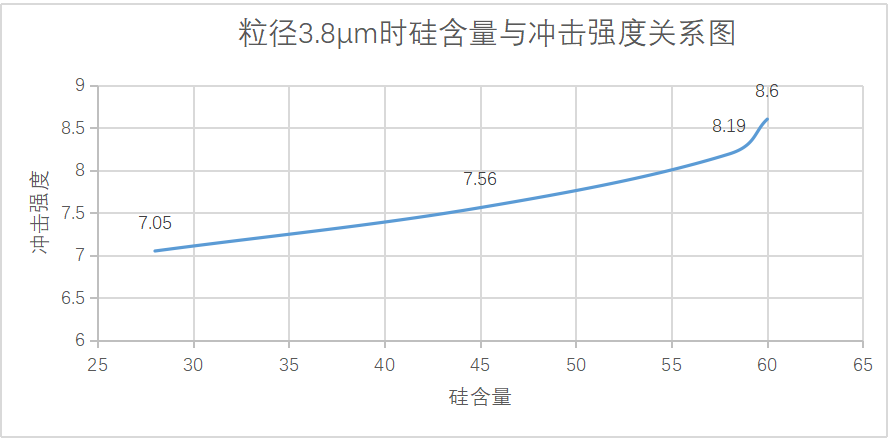
Experiment 1: All impact‑strength data were measured with 20% talcum powder of 3.8 μm particle size.
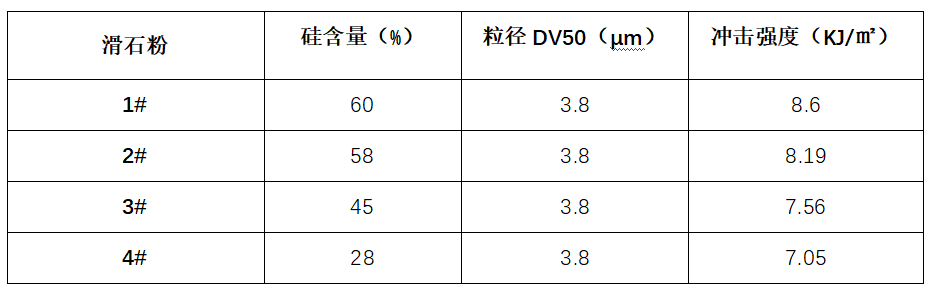
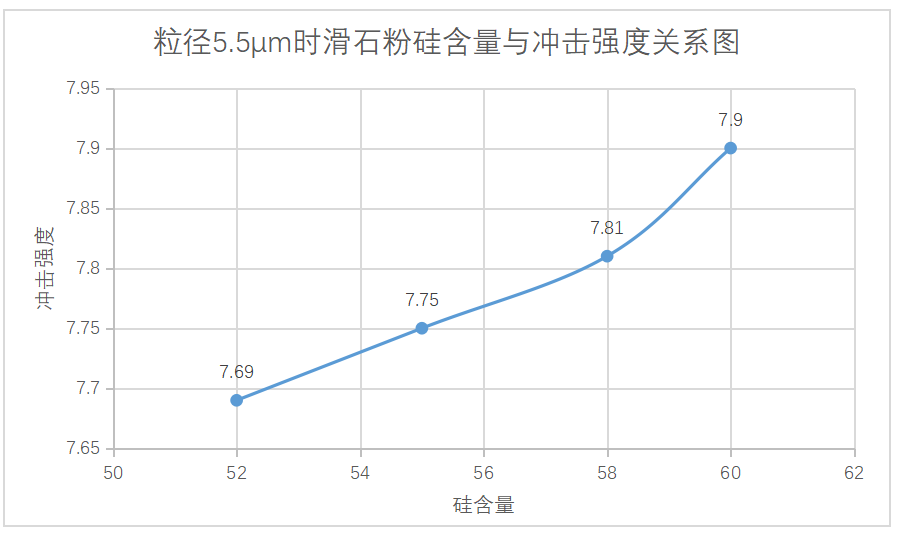
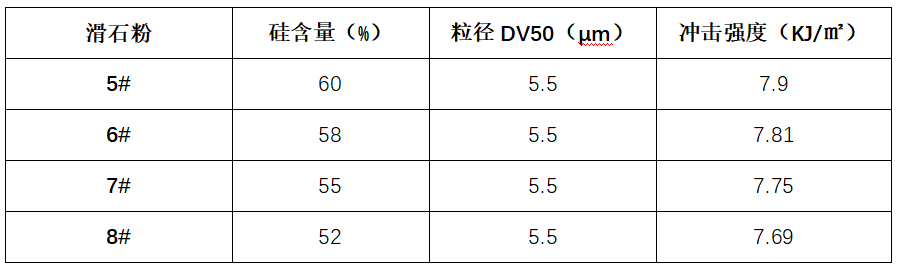
Experiment 2: All impact‑strength data were measured with 20% talcum powder of 5.5 μm particle size with varying silicon contents.
III. Result Analysis
It can be seen from the above test data that impact strength shows an obvious upward trend as the silicon content of talcum powder increases. The higher the silicon content, the higher the impact strength.
The silicon content of polypropylene exerts a certain but relatively minor influence on the impact strength of plastics, indicating that silicon content is not the primary influencing factor. Polypropylene is a high‑rigidity polymer containing methyl groups in its molecular chains, which endows polypropylene with considerable rigidity yet poor toughness. Higher silicon content in talcum powder corresponds to better sheet‑like structure of talcum powder, delivering a prominent stiffening effect without toughening effect. The improvement in impact strength brought by talcum powder mainly stems from enhanced rigidity, which enables plastics to absorb more energy before yielding deformation and thus raises the measured impact‑strength value. In practice, adding talcum powder into PP (polypropylene) usually reduces impact strength — a typical industry observation. Nevertheless, talcum powder with higher silicon content produces a smaller degree of such reduction.
In short, talcum powder cannot improve toughness (i.e., impact strength), yet talcum powder with high silicon content causes a smaller drop in impact strength.