Liu Wei, Liaoning Xinda Talc Group Co., Ltd
Talc is a typical natural layered hydrous magnesium silicate mineral. As a core variety of non‑metallic mineral resources, it is widely applied in coatings, plastics, ceramics, cosmetics, new materials and many other fields owing to its unique chemical structure and stable physicochemical properties. The chemical type of talc directly determines its purity, whiteness, stability, processing performance and industrial application scenarios. The chemical classification, structural differences and compositional characteristics of talc constitute the fundamental basis for ore selection, quality inspection and deep‑processing applications.
I. Fundamental Crystal‑Chemical Nature of Talc
The standard chemical formula of talc is Mg₃Si₄O₁₀(OH)₂, with theoretical chemical components of 63.47% silicon dioxide, 31.68% magnesium oxide and 4.85% structural water. It is a monoclinic layered silicate mineral belonging to the trioctahedral layered silicate of the talc group.
Its core crystal structure is a typical TOT three‑layer sandwich structure: two layers of silicon‑oxygen tetrahedra enclose one layer of magnesium‑oxygen octahedra. Intralayer chemical bonds are strong, while interlayer connections rely only on weak molecular bonds. This special structure endows talc with an extremely low Mohs hardness (grade 1), excellent lubricity, hydrophobicity, chemical inertness and heat resistance. Meanwhile, it governs the variation rules of talc chemical types: metal ion substitution in the layered structure, isomorphous replacement of impurities and intergrowth of associated minerals are the root causes for the differentiation of talc chemical types.
Virtually no absolutely pure‑phase natural talc exists. Ion substitution and mineral intergrowth readily occur during mineralization, causing chemical compositions to deviate from theoretical values and forming talc ores of different chemical types. This also serves as the core basis for quality grading of industrial talc.
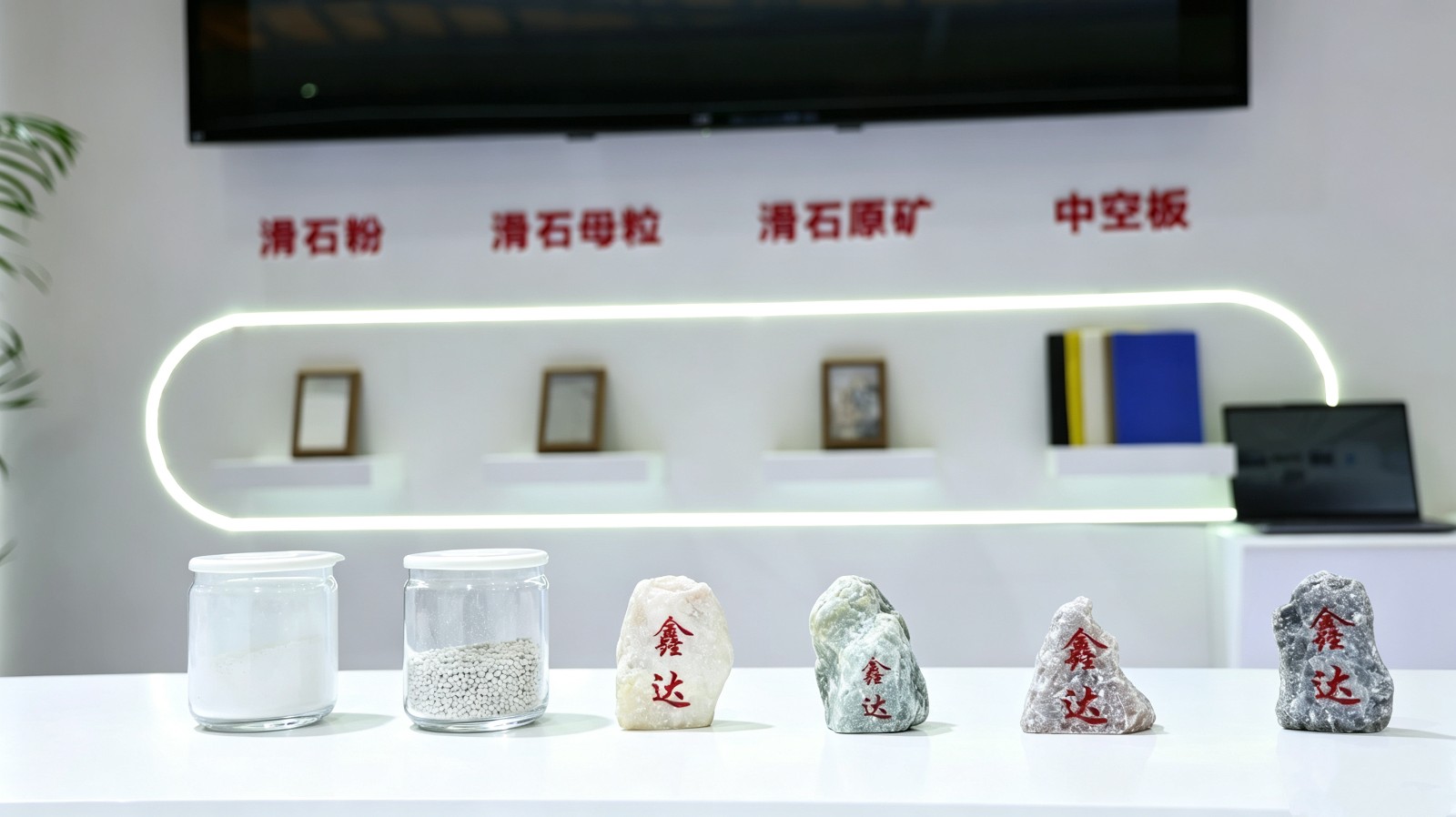
II. Core Chemical Types Based on Isomorphous Substitution
Isomorphous substitution is the primary internal cause of chemical variation in talc. Elemental differences in ore‑forming hydrothermal fluids and surrounding rock media may replace magnesium ions in the octahedral layers of talc with other metal ions, forming modified chemical subtypes of talc. Different substituting elements directly alter the physicochemical properties of talc.
(1) Pure‑Magnesium Standard Talc
This type represents ideal stoichiometric talc with an extremely low degree of ion substitution, and its chemical composition approximates the theoretical value infinitely. Magnesium ions occupy an absolutely dominant position in octahedra of the ore, with extremely low contents of impurity elements such as iron, aluminium, nickel and manganese, and no obvious isomorphous replacement.
Chemical characteristics**: High component compliance rate, stable loss on ignition, intact structural water, high whiteness, outstanding chemical stability, good acid‑alkali resistance, excellent insulating property and ultra‑low coefficient of thermal expansion.
Mineral properties: Well‑developed crystal integrity, regular lamellar structure, and optimal lubricity, hiding power and hydrophobicity among all talc types.
Industrial applications: As high‑grade special talc, it is mainly used in fields with stringent requirements for purity, safety and stability, including cosmetic raw materials, food additives, high‑grade ceramic glazes, pharmaceutical excipients and high‑end electronic insulating materials.
(2) Iron‑Substituted Talc
It is the most common chemical variation type of natural talc. Ferruginous talc solid solutions form when surrounding rocks contain high iron content during mineralization.
Chemical characteristics: Markedly increased iron oxide content and relatively decreased magnesium oxide content. As iron substitution rises, ore colour transitions from pure white to light green, light yellow and grey‑black.
Property changes: Iron impurities exert major negative impacts on the insulating and high‑temperature resistance of talc. Higher iron content corresponds to poorer insulating performance of talc, and yellowing or discoloration tends to take place upon high‑temperature calcination, though ore toughness improves slightly.
Application limitations: Mostly used in ordinary coatings, rubber fillers, industrial putty and low‑end plastic products. Prohibited for food, cosmetic and high‑end insulating material applications.
(3) Aluminium‑Substituted Talc
Mostly formed in aluminium‑rich metamorphic surrounding rock environments. Minor isomorphous replacement occurs in the octahedral layers of talc, often accompanied by doping of trace charge‑compensating ions. It falls into the category of moderately‑low‑variation talc.
Chemical characteristics: Elevated aluminium oxide content, moderate ore purity, slight distortion of crystal structure and slight reduction in lamellar integrity.
Property features: Moderate whiteness, better adsorptivity than pure‑magnesium talc, slightly enhanced chemical activity and favourable thermal stability.
Application scenarios: Widely used as fillers for papermaking, ordinary ceramics, waterproof materials and filling modification of daily‑use plastics. It is the general‑purpose talc with the largest industrial consumption.
(4) Trace‑Metal‑Substituted Talc
Talc from some mining areas exhibits substitution phenomena of trace ions such as nickel, manganese and titanium, representing special niche chemical types. Titanium substitution reduces talc whiteness, while manganese and nickel substitution alter ore colour and chemical activity. Such talc shows distinct impurity features and uneven quality. It usually coexists with other substitution types and is generally classified as ordinary industrial‑grade talc, only applied in low‑end industrial filling fields.
III. Industrial Chemical Types Based on Mineral Paragenetic Assemblages
From the perspective of overall ore chemical composition and paragenetic mineral systems, natural talc ores are divided into four major chemical assemblage types in industry. This classification is more consistent with actual mine exploitation, mineral processing and industrial applications, and constitutes the mainstream standard for mineral detection and grade classification.
(1) Pure Talc Type
Mineral composition is dominated by single natural talc with talc mineral proportion ≥90% and very few associated impurities, only containing trace quartz and calcite. Its chemical composition is close to standard talc, total impurity oxides are below 5%, and structural water content meets specifications.
Ores of this type feature high crystallinity, intact lamellae and excellent whiteness. They serve as core raw materials for high‑grade talcum powder. After ultrafine grinding and purification, they can satisfy the usage standards of high‑end industries. High‑quality mining areas such as Dashiqiao in Liaoning Province of China mostly produce this type of talc.
(2) Chlorite‑Paragenetic Talc
It is the most widely distributed talc chemical assemblage type across the globe, with chlorite (hydrous aluminium‑magnesium silicate) as the dominant associated mineral. Talc and chlorite occur in layered paragenesis and interwoven distribution.
Chemical characteristics: The ore has a high overall Al₂O₃ content and contains lattice structural water of chlorite, with favourable chemical composition stability. Chlorite and talc are both layered silicates with similar structures and extremely high compatibility.
Performance advantages: Uniform ore hardness, good wear resistance, strong hiding power and excellent processing flowability.
Industrial uses: Mainly applied in coatings, printing inks, plastic modification and building waterproof materials. It is the talc raw material type with the highest cost‑performance ratio in industry.
(3) Carbonate‑Paragenetic Talc
Also referred to as magnesite‑dolomite type talc, its associated minerals are mainly carbonate minerals including magnesite, dolomite and calcite.
Chemical characteristics: High calcium oxide and magnesium oxide contents in ores, high loss on ignition, slight reaction with weak acids, and inferior chemical stability compared with pure talc and chlorite‑paragenetic talc.
Property features: Good whiteness, strong adsorptivity and high packing density, yet poor acid resistance and hydrophobicity.
Application scenarios: Primarily used in low‑end fields such as papermaking fillers, chemical fertilizer filling, ordinary building materials and refractory materials. Not suitable for acid‑alkali‑resistant or waterproof scenarios.
(4) Tremolite‑Impurity Talc
It is a low‑quality talc chemical type, whose associated minerals are mainly amphibole group minerals represented by tremolite.
Chemical characteristics: Complex impurity components in ores, trace calcium and iron impurities, poor lamellar integrity of crystals interwoven with fibrous minerals, low purity and poor stability.
Performance drawbacks: Greatly decreased lubricity and hydrophobicity; some ores contain trace harmful impurities.
Application scope: Only adopted in low‑requirement scenarios such as industrial putty, low‑end filling materials and paving auxiliaries. Strictly prohibited for daily‑chemical, food and medical fields.
IV. Chemical Type Characteristics of Talc with Special Genesis
(1) Chemical Type of Black Talc
A special talc variant high in silicon and low in magnesium, mainly occurring in sedimentary‑metamorphic deposits, and characterized by trace doping of organic matter and carbonaceous matter.
Chemical parameters: SiO₂ content can reach above 63% with low iron impurity content. Trace carbonaceous matter imparts grey‑black to jet‑black colour. Organic matter decomposes upon high‑temperature calcination, converting it into high‑whiteness talc.
Core properties: Compact ore structure, uniform fineness and extremely strong hiding power. It is premium talc specially for ceramics and antique‑style building materials. Guangfeng in Jiangxi Province is the core domestic producing area of black talc.
(2) Metamorphic Lamellar Talc
Talc formed by regional metamorphism, featuring high chemical purity, low ion substitution, large crystal grain size and highly developed lamellar cleavage.
Chemical advantages: Extremely low total impurities, stable whiteness and uniform physicochemical properties. It is the optimal raw material for producing cosmetic‑grade and pharmaceutical‑grade talcum powder.
V. Summary of Industrial Value of Talc Chemical Types
The chemical type of talc acts as the core indicator determining its quality and applications: pure‑magnesium non‑substituted talc is high‑grade special raw material suitable for high‑end sophisticated fields; aluminium‑ and iron‑substituted talc are general‑purpose industrial raw materials for traditional filling industries; chlorite‑ and carbonate‑paragenetic talc are mainstream mass‑produced raw materials for bulk industrial scenarios; tremolite‑impurity talc and black talc are functionally‑segmented raw materials for dedicated building material and ceramic fields.
In mineral detection and industrial applications, talc chemical types can be accurately identified by testing the contents of SiO₂, MgO, Fe₂O₃, Al₂O₃ and loss on ignition, so as to match processing technologies and application scenarios and realize refined and high‑value utilization of talc mineral resources. Meanwhile, the chemical variation and paragenetic rules of talc provide important theoretical foundations for talc ore exploration, mineral processing‑purification and modified deep processing.