Liaoning Xinda Talc Group Co., Ltd. - Li Hongpeng
The reason why talc powder (mainly composed of hydrated magnesium silicate) can shine in the papermaking field is due to its series of excellent natural properties:
1. High whiteness and low abrasion: High quality talcum powder has a high natural whiteness, which does not reduce the whiteness of the paper, but instead enhances visual aesthetics. Its Mohs hardness is extremely low (about 1), and it has minimal wear on papermaking equipment and wear parts, protecting production equipment.
2. Flake structure: This is the core advantage and basic property of talc powder: its microscopic crystals are flat sheets, which endow it with excellent coverage and lubricity, and can significantly improve the surface properties (smoothness, glossiness) and hand feel of paper.
3. Contradictory dual properties, hydrophilicity and hydrophobicity: Talc powder contains hydrophobic groups such as methyl and ethyl, which make it exhibit a certain degree of hydrophobicity. At the same time, it also contains hydrophilic groups such as hydroxyl groups, which can form hydrogen bonds with water molecules, thus exhibiting a certain degree of hydrophilicity.
4. Chemical inertness and stability: Talc powder has very stable chemical properties and is not easily reacted with other chemicals in the papermaking system, making it safe and reliable to use.
5. Good adsorption: Its sheet-like structure provides a large specific surface area, which can effectively adsorb impurities and harmful substances in the system. Usually, the larger the specific surface area and the smaller the particle size, the better the adsorption effect, but it also adds some difficulty to the processing technology during processing.
This article mainly focuses on the high whiteness attribute of talc powder and studies the effect of talc powder on paper whiteness, using data provided by the R&D center of Liaoning Xinda talc group Co., Ltd. as a reference.
Experimental materials and equipment:
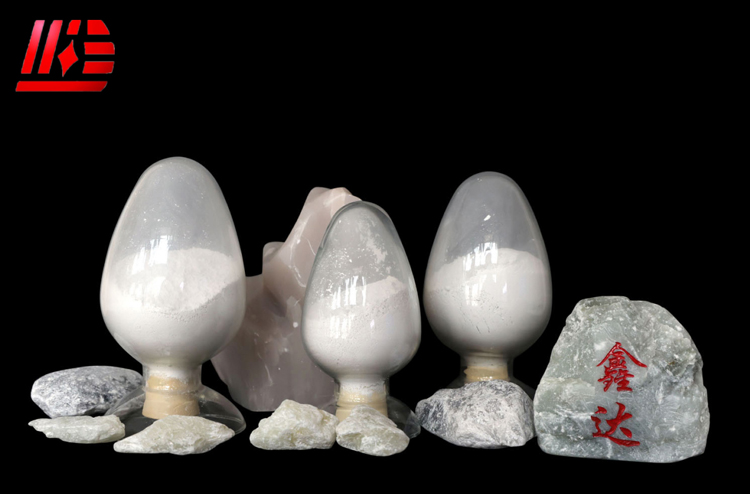
The experiment used three different types of talc powders with similar whiteness and particle size (talc powder was provided internally by our company, and the detection data was true and effective). Diluted AKD and PAM reagents, cationic starch solution, pure water, and broad-leaved wood pulp. The moisture content of broad-leaved wood pulp was determined by drying method, with a moisture content of 9.386%.
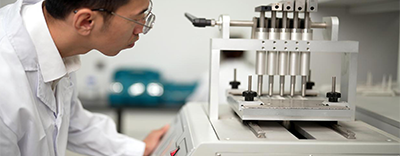
The experimental equipment includes TD6-23 Vali Beater, J-DJY100 Beating Degree Tester, TD10-200 Paper Forming Machine, and GBJ-A Fiber Disseminator.
The testing equipment mainly uses ZB-B whiteness tester, J-SLY1000 paper tearing tester, DCP-HY10k computer-controlled smoothness tester, DCP-KZ300 computer-controlled paper tensile tester, DCP-NPY1200 computer-controlled paper bursting tester, and adjustable distance paper cutter.
Experimental method:
Preparation of slurry:
(1) Based on the moisture content of 9.386% and the beating concentration of the pulp, it is calculated that 397.3g of wood pulp is required. Before adding it to the beating machine, soak it in 5L of water for more than 4 hours, and then tear it into small pulp pieces of 25mm x 25mm.
(2) Slurry release: ① Before loading, add 17L of water at a temperature of (20+5) ℃ to the slurry tank of the beater, then start the beater and slowly add the slurry into the machine for 3-5 minutes. After loading the material, add water to the total volume of the slurry and water, which is about 23L, to achieve a pulp concentration of about 1.565%. Adjust the temperature of the slurry to (20+5) ℃, then loosen it until there are no small slurry blocks. ② During the evacuation process, the bottom blade lever arm should be moved up and down 1-2 times to allow the slurry hanging behind the flying blade and adjacent baffles to fall down. The evacuation operation is generally controlled within 30 minutes. During the thinning process, samples are taken to measure the degree of beating, and when it reaches 30 ° SR, the thinning and beating are completed.
(3) Diluted pulp: Calculate the number of sheets of paper to be made and the weight of the required pulp. This experiment is divided into three groups with a total of 60 sheets of paper. According to the national standard for paper making, the required dry weight and pulp addition amount are calculated based on a paper weight of 60 ± 3g/㎡. Then, calculate the required amount of AKD, PAM, cationic starch, and three different whiteness talc powders to be added. After adding the diluted pulp, prepare the paper for making.
(4) Paper copying experiment: Open the slurry storage chamber, place the forming net on the support net, then tighten the slurry storage chamber, close the drainage pipe of the suction chamber, inject water into the slurry storage tray until about 4L is reached, pour in the prepared slurry, continue to add water until the total volume reaches 7L, and stop injecting water. Open the blow valve for 5-7 seconds, stir the adhesive, then let it stand for 5 seconds, open the drain valve, vacuum it, and peel off the paper to dry.
Data detection:
The main focus of this experiment is to compare the whiteness. Using the paper made from the lowest whiteness 1 # talc powder as a benchmark, the whiteness of 2 # and 3 # increased by 5% and 9%, respectively. Specific detailed data cannot be disclosed due to confidentiality reasons. In summary, talc powder with higher whiteness can have a positive impact on the whiteness of paper in papermaking experiments. But in actual production, the manufacturer shall prevail.