Zheng Yi, Liaoning Xinda Talc Group Co., Ltd.
I.Oil-Loving and Water-Repellent Mechanism of Talc Powder and Functional Groups Enabling Such Performance
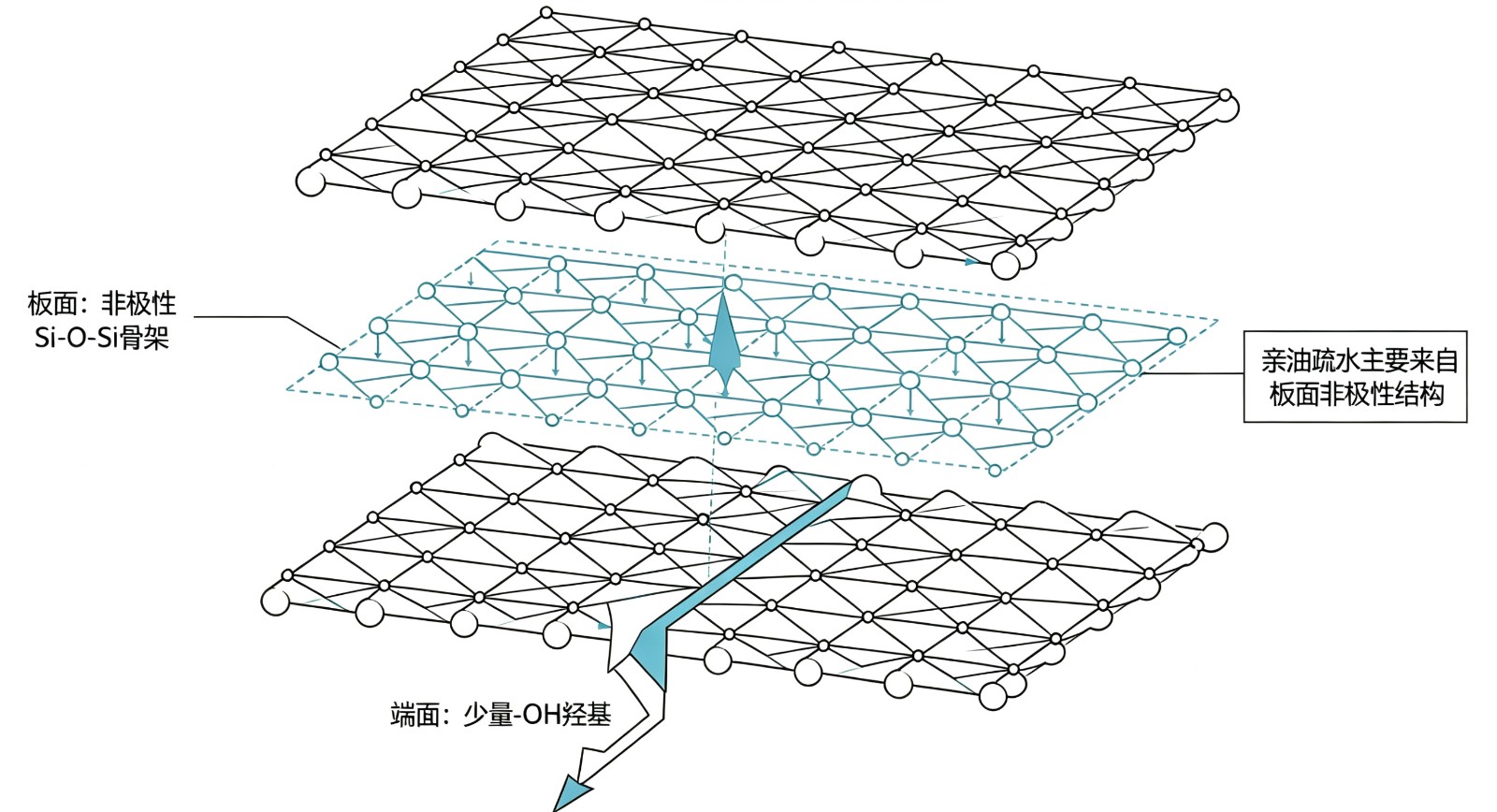
The theoretical chemical structural formula of talc mineral is Mg₃Si₄O₁₀(OH)₂, a typical layered hydrous silicate crystal of 2:1 type. Its crystal structure consists of layered units formed by one magnesium hydroxide octahedral sheet sandwiched between two silica tetrahedral sheets. The layers are bound by weak van der Waals forces and can easily separate to form lamellar microcrystalline structures.
Analysis from the perspectives of surface functional groups and interfacial polarity:
1. Dominant functional groups on crystal basal planes: The basal plane of talc lamellae is dominated by continuous non-polar skeletal Si–O–Si siloxane bridges, exhibiting non-polar characteristics similar to long-chain alkanes with no exposed polar hydrophilic groups, thus delivering strong non-polar oil-loving and water-repellent properties.
2. Secondary functional groups on crystal edge surfaces: Only a small amount of polar hydroxyl groups (–OH) are exposed on fractured edge surfaces of talc particles. Edge surfaces account for an extremely low proportion and exert negligible polar effects, failing to alter the overall surface polarity.
3. Mechanism of like dissolves like: Oily resins, solvents and mineral oils all feature non-polar long carbon chain systems (–CH₃, alkyl, aromatic hydrocarbon chains). In accordance with the like-dissolves-like principle, the non-polar siloxane framework on talc surface interacts intensely with non-polar oil-phase molecules, enabling rapid wetting and spreading. Water, by contrast, is a highly polar molecule that generates high interfacial tension with the non-polar basal planes of talc and exhibits extremely poor wetting capacity.
In summary, the native talc surface is predominantly composed of non-polar siloxane structures with an extremely low proportion of polar hydroxyl groups, which constitutes the fundamental chemical reason for its natural oil-loving and water-repellent performance. It can achieve favorable dispersion, flocculation resistance and sedimentation resistance in oily systems without surface modification.
II.Core Causes of Excessively High Oil Absorption Value of Talc Powder
Oil absorption value refers to the mass of standard oil required to fully wet the surface of unit mass powder and fill internal stacking pores. It is a physical structural indicator jointly determined by powder micromorphology, crystal structure, specific surface area and particle stacking mode, and belongs to a performance dimension separate from surface lipophilicity.
1. Lamellar crystal morphology effect: Talc features a natural layered sheet structure with thin flaky particles. Tight close packing of particles cannot be realized, and interlayer bridging voids and internal interlayer pores readily form.
2. High specific surface area effect: Sufficient delamination occurs after talc is ground and split. Particle size refinement is accompanied by a remarkable increase in specific surface area, requiring more resin or oil to wrap and wet single particles.
3. Stacked pore structure effect: Random stacking of flaky powder forms massive open micropores, connected slits and hollow cavities, endowing talc with physical oil storage and adsorption capacity analogous to porous media.
4. Comparative verification: Ground calcium carbonate mostly presents dense spherical and cubic crystal forms with compact particle stacking, no bridging voids and low specific surface area. Even after surface modification to achieve lipophilicity and hydrophobicity, it lacks oil storage space, hence its oil absorption value is far lower than that of talc.
Conclusion: The high oil absorption value of talc is not caused by its lipophilicity; instead, it is dominated by physical structural properties including flaky crystal morphology, high specific surface area and porous void structures formed via random stacking.
III. Internal Correlation Between Talc’s Oil-Loving Water-Repellent Property and Its High Oil Absorption Value
1. Essential distinction of properties
Oil-loving and water-repellent performance is a surface chemical interfacial characteristic determined by the polarity of surface functional groups and surface energy. Oil absorption value is a macroscopic physical structural characterization governed by particle morphology, particle size distribution, specific surface area and stacking porosity. The two mechanisms are independent and cannot be equated.
2. Coupling correlation
Lipophilicity and hydrophobicity serve as the prerequisite for high oil absorption: The natural non-polar surface of talc can be completely wetted by oily media, allowing oil-phase molecules to spontaneously penetrate and fill interlayer gaps and internal micropores, so all structural voids can function for oil storage. If powder surfaces are hydrophilic and oleophobic, oil phases cannot wet or permeate the pores, which will remain unsaturated with oil and yield a low oil absorption value despite existing voids.
Lipophilicity does not inevitably lead to high oil absorption: Modified calcium carbonate can achieve strong lipophilicity and hydrophobicity via surface coating, yet its dense crystal structure lacks porous frameworks and oil storage space, resulting in a consistently low oil absorption value. This fully proves that lipophilicity is the basis for wetting, while porous flaky structures act as the decisive factor for high oil absorption.
3. Correction of industry cognitive misconception
It cannot be simply concluded that "higher lipophilicity corresponds to higher oil absorption". Surface chemical polarity only determines whether oil can wet and enter pores, whereas the microscopic physical structure of powder dictates the oil storage capacity.
IV. Professional Technical Solutions to Excessively High Oil Absorption Value of Talc Powder
1. Precise regulation of particle size and particle size distribution
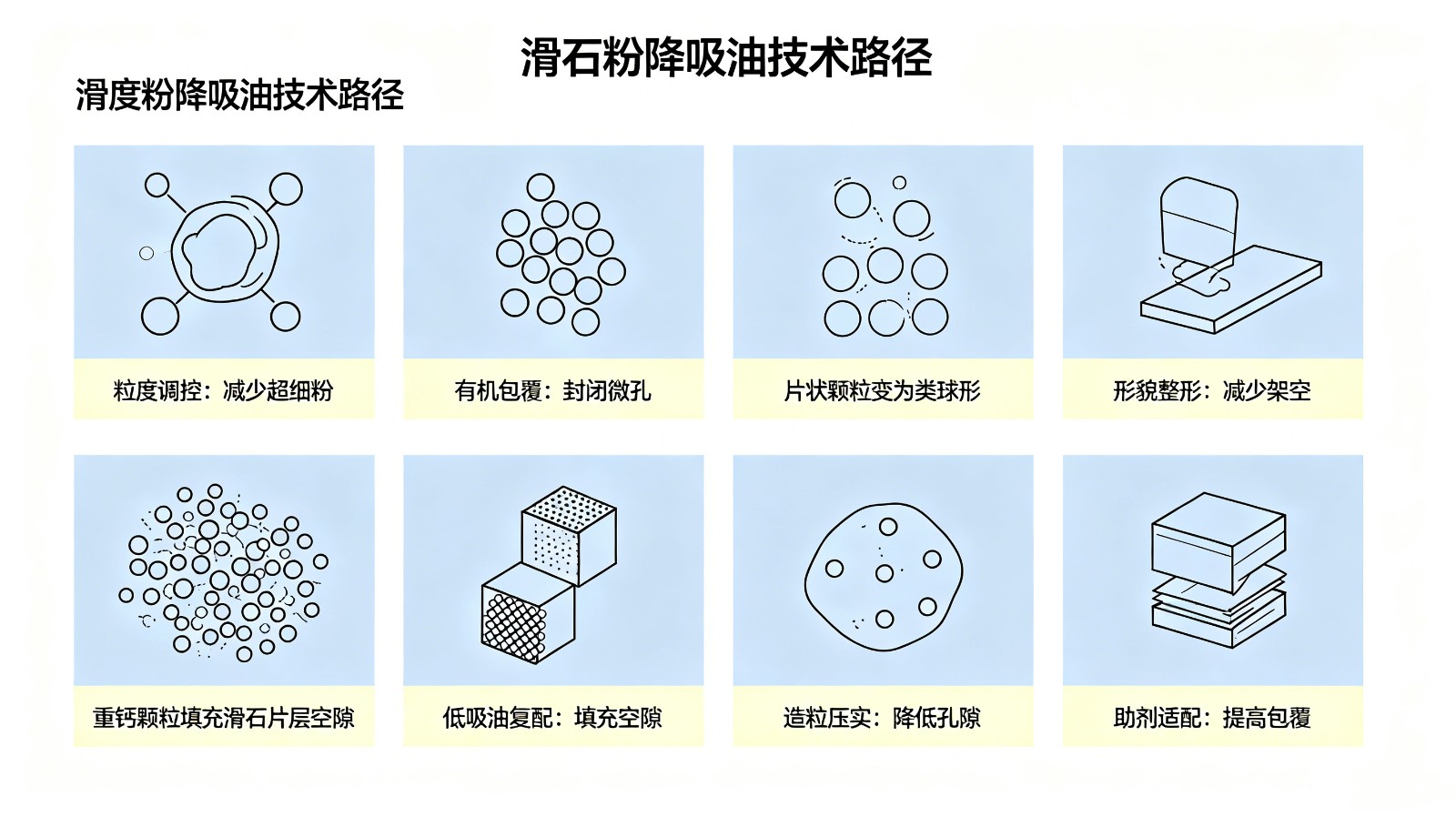
Select talc powder with large particle size and low mesh count, strictly control the proportion of ultrafine powder to reduce powder specific surface area, and restrict excessive mechanical grinding and delamination to mitigate ultra-thinning of lamellae. This reduces pores and surface adsorption sites from the structural source and directly cuts the baseline oil absorption value.
2. Surface organic coating modification treatment
Adopt modifiers such as stearic acid, fatty acid salts, silane coupling agents, titanate coupling agents, paraffin wax and low-molecular-weight resins to directionally coat talc particle surfaces and lamellar edges: seal surface defects and micro-nano pores, passivate adsorption sites in interlayer gaps, lower surface free energy and effective specific surface area, and significantly suppress oil absorption value while retaining lipophilic dispersibility.
3. Particle morphology shaping and crystal form regulation
Adopt mechanical shaping and wet grinding modification processes to weaken the tendency of talc lamellar delamination, convert partial flaky particles into near-spherical and ellipsoidal shapes, optimize particle stacking status, lower void ratio formed by lamellar bridging, and reduce physical oil storage space.
4. Compound filling with low oil-absorption powder
Carry out gradient compounding with dense low-oil-absorption powders such as ground calcium carbonate, quartz powder and calcined kaolin. Filler particles fill bridging voids formed by stacked talc flakes to lower the overall system porosity and average oil absorption value, meeting formulation requirements of coatings, plastics and rubber.
5. Control of production process parameters
Optimize powder classification, dispersion and granulation processes to avoid sharp increases in specific surface area induced by over-crushing and over-delamination. Apply granulation technology to convert fine talc powder into granular materials for compacting internal pores and shrinking stacking voids, thus controlling oil absorption indicators during processing.
6. Adaptation of auxiliary agents in formulation systems
Match high-efficiency wetting dispersants and rheology modifiers in coating, plastic and rubber formulations to improve the wetting and wrapping efficiency of resins on talc particles, reduce oil consumption for filling voids with free oil, and equivalently cut actual oil absorption consumption at the formulation application level.