Deng Xianghui, Liaoning Xinda Talc Group Co., Ltd.
Talc is a widely used inorganic filler in the field of plastic modification. Talc is oleophilic and hydrophobic, has good compatibility with polymer matrices, and its flaky structure can significantly improve the rigidity of plastics.
However, the optimal proportion of talc to be added to plastics needs to be determined according to the performance requirements of the material. Factors to be considered include density, impact strength, flexural modulus, shrinkage rate, and others. This paper discusses the effect of different addition ratios of talc on plastics.
The discussion and analysis will first be conducted based on experimental data.
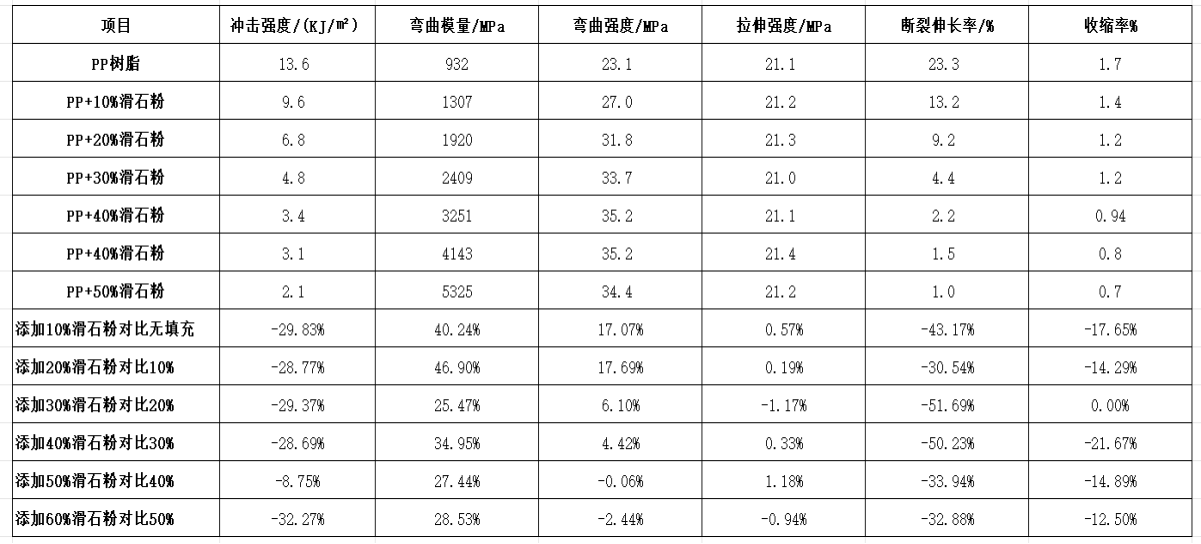
Table: Experimental Data of Talc at Different Addition Ratios
From the data, we can draw several simple conclusions:
1. As the proportion of talc added increases, the impact strength and elongation at break gradually decrease, indicating that the higher the talc content, the poorer the toughness;
2. As the proportion of talc added increases, the flexural modulus and flexural strength continuously improve, indicating that the higher the talc content, the stronger the rigidity;
3. The tensile strength fluctuates slightly, indicating that the talc content has little effect on tensile strength, which largely depends on the inherent properties of polypropylene (PP);
4. The addition of talc can greatly reduce the shrinkage rate of plastic products.
The experimental data show that the proportion of talc added presents a linear trend with the main properties of plastics: some properties are improved while others are reduced. There is no single universally optimal proportion.
Generally, however, in the plastics industry, taking PP as an example, a 20% addition ratio is common, as it results in relatively balanced overall performance.
Cause Analysis
The flaky structure of talc, when uniformly distributed in the resin matrix, can inhibit the yield deformation of plastics. This effect becomes more pronounced as the addition amount increases, leading to an upward trend in flexural modulus and flexural strength.
Although talc is uniformly distributed in the resin, it also forms interfaces between talc and the resin as distinct substances. Talc and polypropylene do not form an overall continuous phase; the larger the interfacial area, the more easily the material fractures. Consequently, impact strength and elongation decrease significantly as the filling ratio rises.
The effects of talc on plastics may also occur with other inorganic fillers, but this depends on the microstructure of the inorganic filler. While different inorganic fillers may exhibit similar effects, there can also be substantial differences.